
Train for
what you
race.
Your body. Your mind. Your racing.
Fitness built around your discipline and the equipment you have. Mental preparation for the pressure, decisions and emotions that come with competing.
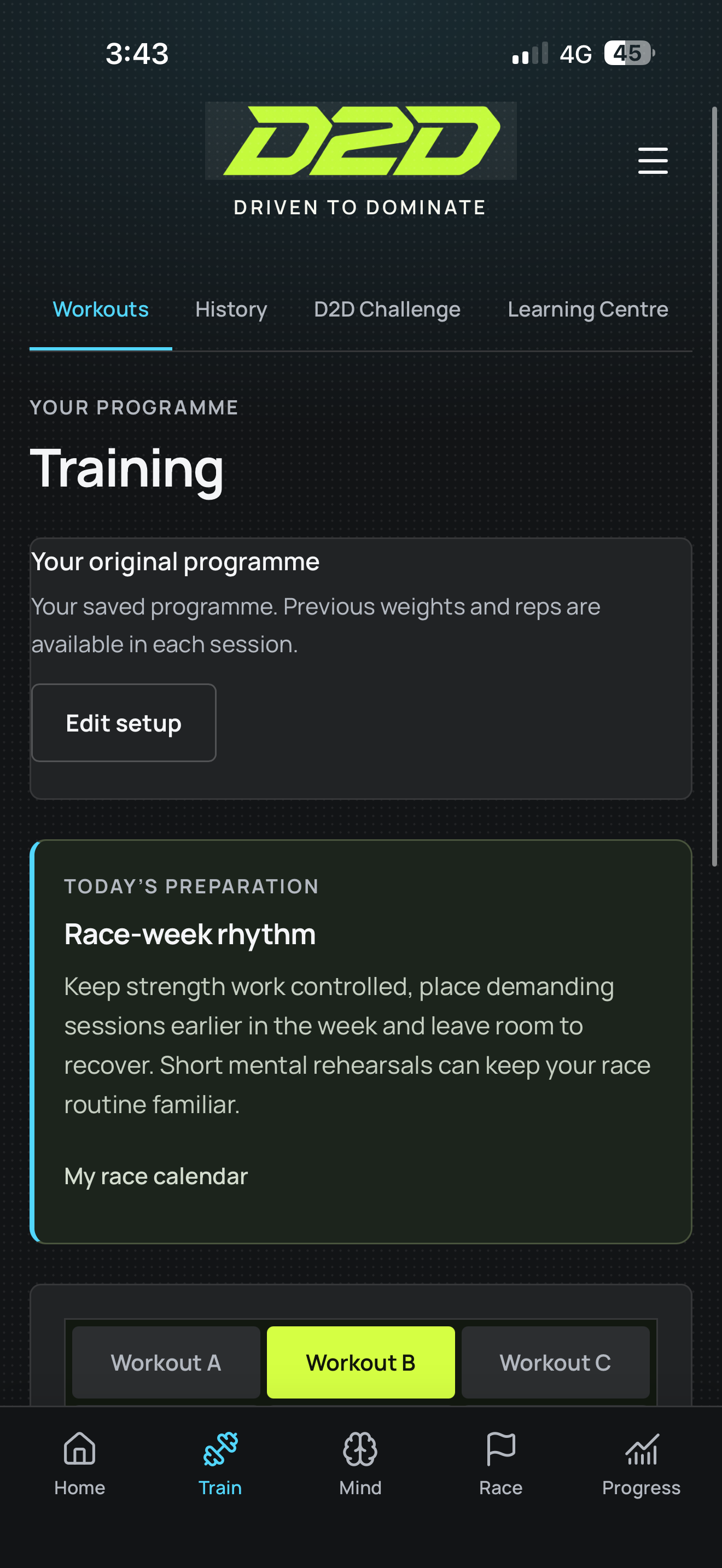
Your discipline.
Your training priorities.
A kart racer with unassisted steering and an endurance racer facing long stints ask different things of their bodies. Your programme should reflect that.
Start with the demands of your race.
Your class, steering or handlebar control, race format and stint length help set the emphasis. D2D uses those details to adjust exercise priorities, repetition ranges, conditioning and the balance of your week.
- 1Tell us what you race
Choose your discipline and class, then describe the demands of your events.
- 2Build around your setup
Select equipment at home, at the gym or while travelling, along with your experience, available time and movement limitations.
- 3Train, record and review
Follow exercise guidance, understand its racing purpose and log your sets, reps and weights. Use your calendar for race-week preparation guidance.
Stay strong through repeated efforts.
- 01Upper-body and grip endurance
- 02Trunk and hip endurance
- 03Recovery between heats
Unassisted steering increases the emphasis on upper-body endurance.
Example priorities from D2D’s programme logic. Your equipment, experience, time and limitations also shape your sessions.
Prepare for the pressure.
Practise your response.
You train the physical skills of racing. D2D gives you a place to work on attention, confidence and composure with the same intention.
Understand what helps you get in the zone.
The Learning Centre explores flow through challenge, perceived skill, clear goals and useful feedback. Use it to understand your own preparation and what helps you feel absorbed in the task.
Then put the learning into practice: visualise a familiar lap, rehearse a response to a race situation, practise a breathing routine, or choose a cue to return your attention to the next task.
Flow is an experience to understand, not a state the app can promise or measure for you.
Explore the support insideWhat does “in the zone” mean?
Work on the conditions.
Let the task hold your attention.
D2D redrawing of concepts discussed in Susan A. Jackson’s Experiencing Flow. No author endorsement is implied.
Start with what you’re dealing with.
Nerves, doubt & fear
Understand what you’re feeling before the start. Explore practical ways to prepare, ground your attention and work through confidence after a setback.
Pressure to perform
Support for team expectations, sponsors, family pressure and the standards you set yourself. Separate the result you want from the next action you can control.
When you’re doing it all
Towing, setting up, crewing and racing is a lot to carry. Find ways to organise the demands, ask for support and give your own preparation some space.
Reset after an incident
Work on your response to frustration, mistakes, getting passed and disappointment. Rehearse how you want to refocus when the next opportunity comes.
Help them feel heard.
Explore how to talk with young racers about nerves, fear, pressure and disappointment. Learn ways to listen, respond and support their confidence—before, during and after a meeting.
Make practice a habit.
See your progress.
Bring physical sessions, mental practice and reaction training into one routine. Keep a record you can return to and build on.
Reactions and focus, wherever you train.
Take on 30-second target challenges, practise responding to the right cue and filter distracting colours in focus games. Track correct hits, accuracy and response times across your sessions.
Train on the screen you already have, or include BlazePods in your physical setup. Compare like-for-like results and challenge your own consistency.
Game scores track performance in that game; they aren’t a measure of on-track reaction time.
See the work you’re putting in.
Return to previous weights and reps. Follow training effort, reaction results and racing performance over time. Use the graphs to spot patterns and choose what to work on next.
Mental practice has its own history, with saved cues, visualisation and mental-lap records to revisit. The goal is to understand what works for you.
The graph uses fictional example data. Progress is individual and won’t always move in a straight line.
Goblet squat
22kgWeights recorded across six example sessions.
View sample numbers
| Session / week | Exercise weight |
|---|---|
| 1 | 16 kg |
| 2 | 18 kg |
| 3 | 18 kg |
| 4 | 20 kg |
| 5 | 18 kg |
| 6 | 22 kg |
Be part of
what’s next.
Choose the part of D2D you’re interested in. We’ll share release news, membership details and development updates.
- Launch news & membership details
- No subscription created
- Opt out whenever you like
Before you
join us.
When can I use the apps?
The products are in development and testing. Join the launch list for membership details and release updates. Driver Development is being prepared for web, iPhone and Android; Driver Rankings and RaceHub are also being developed as dedicated products.
Is D2D only for car racing?
The vision includes cars, karts, motorcycles, boats, snow and other motorsport. Coverage differs by product: Rankings currently starts with selected Australian speedway results, and RaceHub’s first race-night format is Wingless Sprints.
How much will it cost?
Launch pricing will be announced before paid membership opens. Joining the launch list is free and does not create a subscription.
Are prizes available now?
Rewards, community draws and ambassador programmes are part of the vision. Details, eligibility and any confirmed prizes will be announced before those programmes launch. Joining the launch list does not enter you into a draw.
Can parents and clubs get involved?
Yes. Choose Parent / guardian or Club / partner on the launch form. The form is for adults; parents and guardians can register their interest on behalf of younger racers.